

Most American brands discover that visuals can make or break their event marketing success. With over 80 percent of attendees recalling visuals more clearly than spoken messages, display strategies shape first impressions and lasting connections. Choosing the right display visuals is not just about convention hall aesthetics. It is about turning fleeting moments into authentic brand engagement that your audience truly remembers.
Table of Contents
- Display Visuals Defined for Event Marketing
- Types of Display Visuals and Their Uses
- How Visuals Influence Audience Engagement
- Effective Design Strategies for Displays
- Common Mistakes in Event Visual Displays
Key Takeaways
| Point | Details |
|---|---|
| Importance of Display Visuals | Display visuals are critical communication tools that can create immersive experiences and engage potential customers during events. |
| Types of Display Visuals | A combination of physical and digital displays enhances audience engagement and effectively communicates brand messaging. |
| Design Principles | Effective display designs must focus on clarity, consistency, and emotional resonance to ensure core messages are communicated instantly. |
| Common Mistakes | Avoiding overcrowded designs, inconsistent branding, and poor color choices can significantly enhance the effectiveness of event displays. |
Display Visuals Defined for Event Marketing
Display visuals represent strategic graphic elements designed to communicate brand messaging, attract audience attention, and create memorable experiences during marketing events. Event marketing involves live or virtual promotional experiences where audiences interact directly with products or brands through carefully curated visual communication methods.
These visual elements encompass multiple formats including banners, backdrops, signage, digital screens, product displays, and interactive graphics. Their primary purpose extends beyond aesthetic appeal - they serve as powerful communication tools that translate complex brand narratives into instantly comprehensible visual language. Professional marketers understand that compelling display visuals can transform passive observers into engaged potential customers by creating immersive sensory experiences.
Effective display visuals follow several critical design principles. They must be strategically aligned with brand identity, maintain consistent color schemes and messaging, and communicate core value propositions within seconds of viewer engagement. High-quality graphics, precise typography, and thoughtful spatial design help create displays that not only attract attention but also facilitate meaningful brand connections. Event marketing becomes an experiential promotion strategy where visual elements play a pivotal role in creating memorable interactions.
Pro Tip - Visual Strategy: Design display visuals that tell a cohesive story about your brand, ensuring every graphic element connects logically and emotionally with your target audience’s expectations and aspirations.
Types of Display Visuals and Their Uses
Event marketing relies on diverse display visual types that serve unique strategic purposes. Event graphics encompass multiple formats designed to enhance audience engagement, ranging from traditional printed materials to sophisticated digital presentations. Each display visual type offers specific advantages for capturing attendee attention and communicating brand messaging effectively.
Key display visual categories include:
-
Physical Displays
- Banners and flags
- Pop-up displays
- Backdrop stands
- Product pedestals
- Modular exhibition structures
-
Digital Displays
- Interactive touchscreens
- Video walls
- Projection mapping
- LED screens
- Digital signage
Visual merchandising displays utilize strategic graphic placements to create immersive brand experiences. Physical displays provide tangible brand representations, allowing direct audience interaction, while digital displays offer dynamic, customizable communication platforms that can adapt messaging in real time. The most effective event marketing strategies seamlessly integrate multiple display types to create comprehensive, engaging brand narratives.
The selection of display visuals depends on specific event objectives, target audience preferences, and available technological infrastructure. Factors like venue space, audience demographics, and budget constraints significantly influence display visual choices. Successful event marketers understand that display visuals are not just decorative elements but powerful communication tools that can transform passive observation into active brand engagement.
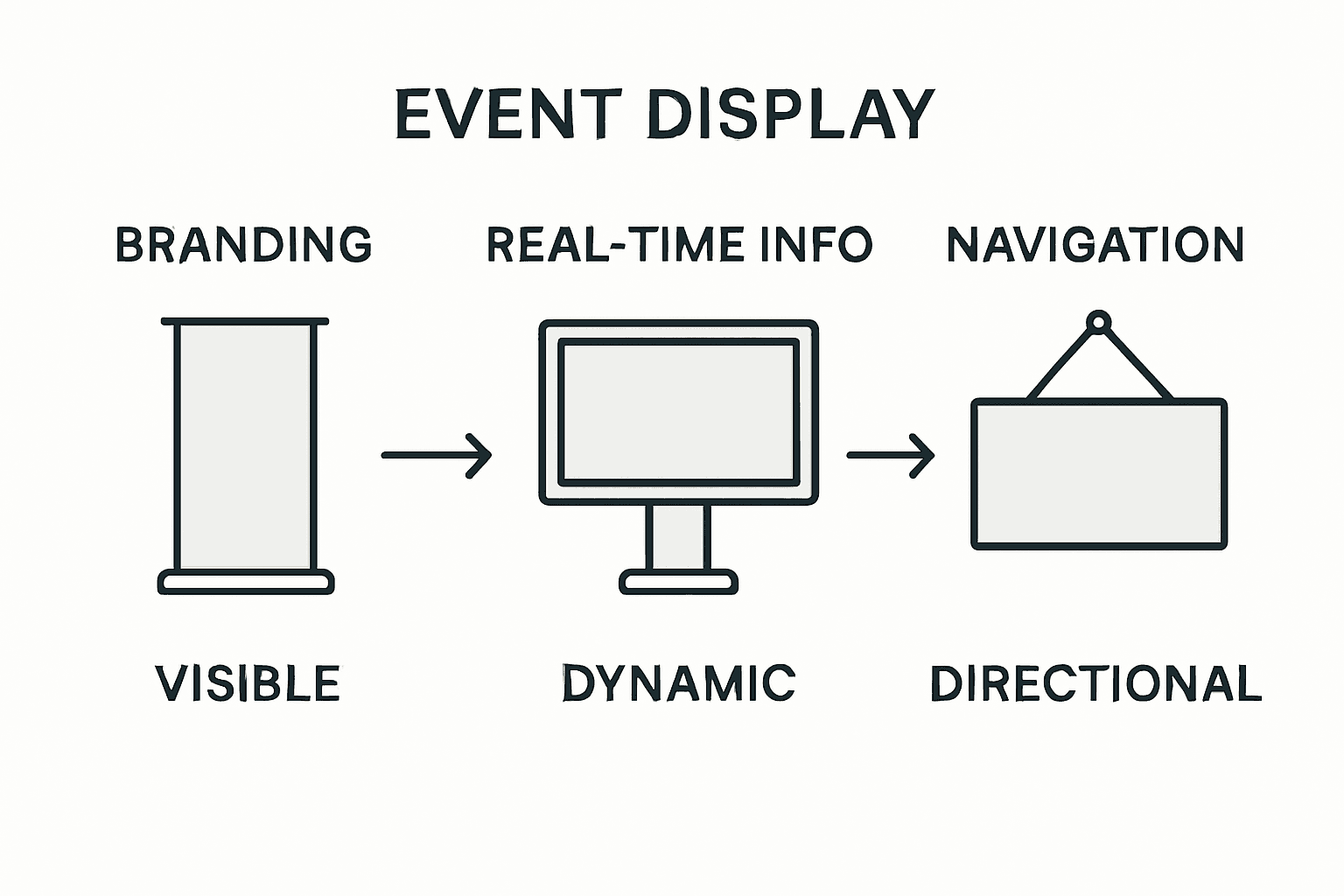
The table below summarizes the business impacts of key display visual types in event marketing:
| Display Type | Engagement Method | Business Impact |
|---|---|---|
| Physical Displays | Tangible interaction | Enhances brand recall |
| Digital Displays | Dynamic real-time content | Boosts audience participation |
| Hybrid Solutions | Immersive multisensory mix | Drives deeper brand loyalty |
Pro Tip - Display Strategy: Develop a cohesive visual strategy that combines physical and digital display types to create a multisensory brand experience that resonates with your target audience.
How Visuals Influence Audience Engagement
Visual communication represents a powerful psychological mechanism for capturing and maintaining audience attention during events. Visual marketing studies the intricate relationship between objects and their visual representation, revealing how strategic visual elements can profoundly influence audience perceptions and behavioral responses.
Psychological Engagement Mechanisms of visual displays include:
- Emotional Triggering: Visuals that evoke immediate emotional responses
- Cognitive Processing: Graphics that simplify complex information
- Sensory Stimulation: Displays that activate multiple sensory channels
- Attention Capture: Design elements that interrupt standard visual scanning patterns
- Narrative Communication: Visuals that tell compelling brand stories
Visual merchandising optimizes product presentation to attract and motivate customers, demonstrating how carefully crafted visuals can transform passive observers into actively engaged participants. The human brain processes visual information approximately 60,000 times faster than text, making graphics an exceptionally powerful communication tool. Effective visual displays create immediate cognitive connections, triggering psychological responses that transcend traditional verbal communication methods.

Successful audience engagement through visuals requires understanding complex perceptual mechanisms. Factors like color psychology, spatial composition, contrast, and symbolic representation play critical roles in how viewers interpret and internalize visual messages. Event marketers must strategically design displays that not only capture attention but also create memorable, emotionally resonant experiences that prompt desired audience actions.
Pro Tip - Visual Engagement Strategy: Design display visuals that create an immediate emotional connection by using authentic, storytelling imagery that reflects your audience’s aspirations and challenges.
Effective Design Strategies for Displays
Designing impactful display visuals requires a strategic approach that goes beyond aesthetic considerations. Effective display design for maximum brand impact demands a comprehensive understanding of visual communication principles and audience psychology.
Core Design Principles for creating compelling display visuals include:
- Clarity: Communicate core messages instantly
- Consistency: Maintain brand identity and visual language
- Contrast: Create visual hierarchy and guide viewer attention
- Simplicity: Avoid visual clutter and information overload
- Relevance: Align visuals directly with event objectives
- Emotional Resonance: Connect with audience through authentic storytelling
Successful display design integrates multiple strategic elements. Color psychology plays a crucial role, with specific color combinations capable of triggering emotional responses and influencing viewer perceptions. Typography and spatial composition further enhance visual communication, guiding the viewer’s eye and creating narrative flow. Professional designers understand that every visual element serves a deliberate communicative purpose beyond mere decoration.
Technical considerations are equally important in display design. Resolution, image quality, material selection, and viewing angles can significantly impact visual effectiveness. Event marketers must consider environmental factors like lighting conditions, viewing distances, and potential audience movement patterns when crafting display strategies. Adaptable designs that maintain visual integrity across different contexts demonstrate sophisticated marketing intelligence.
Pro Tip - Design Strategy: Create display visuals with modular design principles that allow flexible adaptation while maintaining a consistent core visual narrative.
Common Mistakes in Event Visual Displays
Event marketing professionals frequently encounter critical pitfalls that undermine their visual display effectiveness. Understanding the role of displays in audience engagement begins by recognizing and avoiding common design and strategic mistakes that can diminish brand communication.
Top Visual Display Mistakes include:
- Overcrowded Design: Cramming too much information into limited space
- Inconsistent Branding: Misaligning visual elements with brand identity
- Poor Color Choices: Using colors that clash or reduce readability
- Inappropriate Scale: Sizing graphics incorrectly for viewing distances
- Neglecting Context: Failing to adapt displays to specific event environments
- Weak Visual Hierarchy: Not guiding viewer attention strategically
Many event marketers underestimate the psychological impact of visual mistakes. Poorly executed displays can create cognitive dissonance, where viewers struggle to understand the intended message. Typography, color selection, and spatial composition are not mere aesthetic choices but critical communication tools. A single misaligned graphic or inappropriate font can dramatically reduce audience engagement and dilute brand messaging.
Technical execution errors compound design challenges. Resolution mismatches, material selection problems, and inadequate lighting can render even well-conceived designs ineffective. Event displays must withstand diverse environmental conditions while maintaining visual integrity. Professional marketers understand that display visuals are complex communication instruments requiring meticulous planning, precise execution, and continuous performance assessment.
Here is a quick comparison of common visual display mistakes and their potential consequences:
| Mistake | Consequence | Prevention Tip |
|---|---|---|
| Overcrowded Design | Confuses event attendees | Prioritize only essential content |
| Inconsistent Branding | Weakens brand identity | Follow brand guidelines consistently |
| Poor Color Choices | Reduces readability | Select high-contrast color schemes |
| Inappropriate Scale | Diminishes visual impact | Match display size to audience view |
Pro Tip - Error Prevention: Conduct multiple design review iterations and test your display visuals under simulated event conditions to identify and resolve potential communication barriers before final implementation.
Elevate Your Event Success with Impactful Display Visuals
Struggling to create captivating, clear, and emotionally engaging event displays that resonate with your audience Here at Live Displays, we understand that your displays are more than just decoration they are vital communication tools that must align perfectly with your brand and event goals From vibrant Roll Up Banner Stands to customizable gazebos and flags, our solutions help transform your visual strategy into memorable brand experiences that capture attention and drive audience participation
Take control of your event’s visual impact today with our expertly crafted promotional products Explore our wide range of Roll Up Banner Stands – LIVE DISPLAYS and discover custom options designed for clarity consistency and emotional resonance to avoid common pitfalls like overcrowded designs or poor color choices Don’t miss the chance to boost your brand visibility by visiting Live Displays now Start your journey with free artwork proofs and quick quotes tailored to your unique event needs
Frequently Asked Questions
What are display visuals in event marketing?
Display visuals are strategic graphic elements designed to communicate brand messaging, attract audience attention, and create memorable experiences during marketing events. They include various formats such as banners, signage, and digital displays.
How do display visuals influence audience engagement?
Display visuals can capture and maintain audience attention by utilizing emotional triggers, simplifying complex information, and activating multiple sensory channels, ultimately transforming passive observers into actively engaged participants.
What are some common mistakes in designing display visuals for events?
Common mistakes include overcrowded designs, inconsistent branding, poor color choices, inappropriate scaling of graphics, and neglecting the context of the event. These issues can confuse viewers and weaken the brand message.
What design principles should be followed when creating effective display visuals?
Effective design principles include clarity, consistency, contrast, simplicity, relevance, and emotional resonance. These principles help communicate core messages instantly and create a compelling visual narrative.
Share:
What Is Event Marketing and How It Elevates Brands
Trade Show Branding Strategy Guide for Maximum Impact